
An Interview with Zurina
Brigitte Whiting
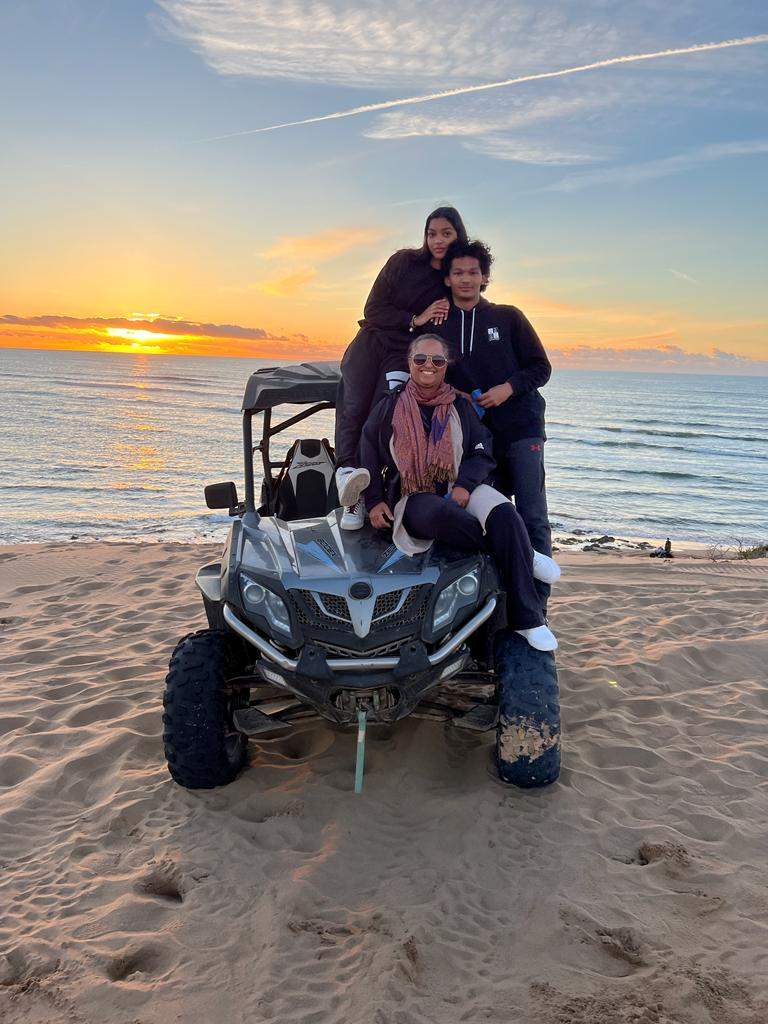
I’m Zurina and currently live in Casablanca, Morocco. I've also lived in other countries— Egypt, South Africa, Turkey, USA. This nomadic existence drew me to writing. I wanted to anchor my kids to South Africa, my home country, and help them understand our history, culture, and language. I initially wrote stories for them, with local South African names, some local words and local faces.
I work full time, which does not leave a lot of space for writing, but I think about words all the time. I have no formal education in writing. My mother never went to high school but she perfected her language through practice. There was always a book by her bed. Nothing fancy— lots of Catherine Cookson and Koontz. Why the latter? I don’t know. She was a widow and lived with two young children. She later confessed that she stopped reading Koontz because he scared the bejeez out of her. She clearly gave value to books. Perhaps that is why I love books so much. We never read together.
Tell us something about yourself. What do you bring from your background into your writing?
To me, writing was initially about telling stories to my children. I was keen to use some local slang in these stories. I wanted them to connect with their heritage. Also, we used to visit our family once a year and the local words helped orientate my kids. My stories for children are often about mothers and kids engaged in a bonding activity like drawing or singing or reading. After writing several stories I realized that I was trying to paint the connection between mothers and children – which is a strong part of my upbringing – and the concept that not all stories about Africans need to depict some form of struggle. Even in the struggle and poverty, there are familial connections that are just about being and loving and caring. In fact, the touchpoints between family members anchor your sense of being and who you are. The images on the television showing struggle and engorged bellies and flies sitting on snot-nosed kids are part of Africa, but only part. There are so many other parts that depict community, survival, love, caring, grit, and the concept that we are all part of each other. I wanted to write those stories.
As my kids grew older, I realized that they live in a bubble far from my home and history. I then thought about writing short stories about the first place I called home – an area always abuzz with people. The language – a blend of other languages – has a musicality. We laugh, even when we are in pain, even when the army is camped outside our homes, even when we cannot see a bright future. I thought I would compile these stories into a collection for my children. I then I realized that I don’t actually know how to write a story. This pained me. It fed into my feeling that I was always trying to overcome some educational deficiency from the past. South Africa and its legacy of segregation always seemed to be lurking, waiting to show me how little was actually spent in developing me as a human with voice.
Determined to learn, I did a search on the internet and found WVU. This has been my main learning platform.
What do you write? Specific genres?
Over time, I discovered that I like literary fiction. I’d like to say that I write literary fiction, but that seems too bold. I try to write literary fiction. I also like to write flash. I enjoy writing about the essence of one moment. It’s not always a story, but it’s something that moves me and the only way I can process the feeling is through words (or at least trying to find the words). More recently, I also started writing essays – thoughts and observations that strike me as I travel to different places. I constantly try to make sense of the world by referring to my reference—my original home. I’m comparing, contrasting, analyzing human behavior. I am drawn to understanding why we do what we do. My essays could be called creative nonfiction. As my writing skills improve, I cannot help but describe what I see around me, what I’m feeling, how it impacts. I’ve also written “poetry.” I put that in quotation marks because I know little about the craft of writing poetry, though I do enjoy poetry (so very, very much). There is a poetry book on my desk—at home and at work—in my bedroom and our living room. I know I can find a description for any emotion and thought in the words of Langston Hughes, Lucille Clifton, Maya Angelou, Joy Harjo, Pablo Neruda, Rumi. I do wish I knew how to write poetry so that I can finish the many “poems” saved on my computer.
As I learn more about writing craft, one of my goals is to edit/revise/rewrite my old stories and get them ready for publication into that compilation of stories/essays for my children.
What classes are you taking at WVU, and how have they helped your writing?
I’ve been a member of WVU for about a decade, but I was not active all those years. Life interrupts—work, moving from country to country, raising children, divorce, losing my mother. Large parts of those years are drowned under the depths of work and raising my kids without a support network because we are far from family. Even in the lean periods I am constantly thinking about writing or reading. When we move, I ship hundreds of books to our new location. After I joined WVU, I tentatively signed up for classes, but often did not have the time or confidence to finish them. More recently, especially, the past 5 years, I spent more time trying to learn.
I am a member of the 29 Rue de Fleurus group. This is my anchor. This is where I experiment. This is where I share all the ups and downs, successes and failures. I do not doubt that I would have given up on writing if I was not part of this group. They help me through everything, including building my writing confidence. I am a lifetime member of WVU because of this group.
Have you published anything?
I tend to write for myself. Perhaps to prove that I can write. But I have had some small success publishing short pieces: a couple of pieces included in Write Yourself out of a Corner by Alice LaPlante; “Promises” in 50-Word Stories; “The Hunt” in Bunbury Issue 18; and “Kirstenbosch” in Akashic Books.
What would you tell anyone who has aspirations to publish something?
Writing is about doing it. I’ve spent so much time thinking about it, beating myself up about it, giving up on it, being annoyed with myself about it. However, in the end, just like anything we do, it only gets done when we actually do it. In terms of process, I think it’s true that the first hurdle is to get the words on the paper. More recently I tell myself, get any words on the paper – write a bad first draft of something. The real writing takes place after the first draft is on the paper. Thinking about writing in this way frees me to jot down anything. It doesn’t really matter if it’s good or bad or if there’s a story or not. Getting the initial words on the page creates space in my mind for other things. It’s like letting the air out of a pressure cooker.
The other thing I’ve learned is that I have to do me. There are so many talented writers in the world and I used to lament the fact that their writing highlights how much I do not know. I used to think that I had to write like them. I’ve tried. It does not work. My stories flow when I write like me, in my voice and my word order. When I stay true to me and my voice, I feel my writing and that is enough—in fact, that is more than enough. Surprisingly, when I do that, I tend to get positive feedback on my writing.
I’ve learned a lot of craft at WVU. A LOT. I arrived without the tools for analyzing writing (I read, but was not a good reader) or the ability to harness key craft concepts into my own writing. WVU has everything we need to succeed. The key ingredient to that success is ME or YOU. We have to show up and try and keep trying.
Is there something you'd like to see offered at WVU?
I sometimes wish there was a place where we could submit finished work for in-line edits.
What is the biggest surprise you've experienced at WVU?
I thought I would learn about craft. The most surprising part is that WVU helped build my writing confidence. Even more surprising, I’ve made friends. Really! I could not have imagined this. It’s a gift and I am really very grateful.
A writer's tip or two you'd like to share.
Writing is not easy. Showing up is the key. That is the hardest part. Sometimes we shy away from a topic because we do not want to excavate parts of our lives or the human condition that pain us. I think that is where the gold lies and we are doing ourselves a disservice when we do not put in the work to get that onto the paper. Of course, I write this so easily, but am guilty of avoidance on a daily basis.
It is natural to be demoralized about writing from time to time (or most of the time). During those periods, I encourage myself to take classes. I try to keep some connection to writing.
Mostly, I tell myself to get something on the page. Anything. One word. When I manage to do this, I always feel like I succeeded, even if no real product results from what I’ve written. It helps to declutter my mind, making space for other ideas and thoughts.
Also, we tend to get different types of feedback from our classmates. Some can be very generous, which is amazing. I learn a lot from those classmates and am grateful for their generosity of time, spirit and care. I feel they’re invested in my learning and think they are modelling a core concept of WVU—we learn from each other.


